My Blog
"Six Action Shoes" by Edward de Bono
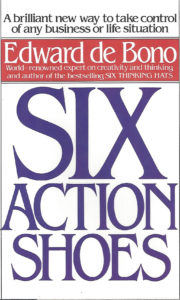 Dr. de Bono is considered the Father of Lateral Thinking, or, as most of us know it, thinking outside the box. This kind of thinking is encouraged these days, but it was unheard of in the 50s, when he began talking to us about it. One of the most well-known illustrations of the concept is in the second Start Trek movie, The Wrath of Kahn, when Kirk solved the no-win Kobayashi Maru test. Either of the two solutions a Star Fleet Academy student had to choose from would end in death. So, Kirk created a third option: He reprogrammed the computer.
That’s lateral thinking in a nutshell. There are never only the obvious solutions to a problem. By using some imagination and ignoring the limits that seem to exist, you can create other options.
His earlier book, Six Thinking Hats, has won endless kudos by major corporations and by primary schools whose kids use it. I think Six Action Shoes is easier to understand if you first understand the hats concept first. Dr. de Bono does not advocate engaging in just one type of thinking. He advocates engaging in one type of thinking at a time, the same as he does with the action shoes later. Dr. de Bono compares it to training a chef. The trainee doesn’t start learning sauces, soups, beef, chick, and seafood all at once; he takes on one subject at a time. You can’t be a chef if you only know one of them, you have to be able to combine them. But not right away. And you really can’t think effectively in six different ways at once. My music education teacher did something very similar with his Problem Reduction approach.
The hats have different colors: white: objective examination of data; red – feelings and intuition; black – devil’s advocate, risk assessment; yellow – examination of the benefits and possibilities; green – creativity (or lateral thinking); and blue – the control hat, the one that makes sure the process is being used properly at every point.
The value is perhaps best illustrated by the black hat, the one that looks at all the reasons it won’t work, everything that can go wrong. No one wants to thoroughly delve into that because it’s depressing and puts you in a negative mindset. But you must look at all that. You must assess all possible risks. Otherwise, you don’t prepare for them, so they do not become stumbling block when you run into one – and you will run into at least one. By making it very clear that this is just one of six steps, it becomes okay to be negative, for a little while.
The Six Action Styles takes up where the hats leave off and you start acting upon what is learned with they showed you. Unlike the hats, the shoes not only have colors, they have styles. There are the navy formal shoe, the grey sneaker, brown brogue, orange gumboots, pink slippers, and purple riding boots.
Different styles of action is nothing new. What Dr. De Bono does is clearly distinguish between them, making it easier to use each one to its best advantage. It’s a valuable read, especially if you are a manager or are in business for yourself. I found the book a bit boring, though. It seemed very repetitive to me. Of course, by seeing it that way, it is possible I missed a lot of the magic of the approach – I should probably go back and read it again – but as I said, I do recommend looking a this way of working, as well as the earlier book, Six Thinking Hats.